How Much Is Too Much… Really?

It amazes me how often clients ask me some version of this question:
“How do I compare to your other clients?”
“Do I have too much stuff?”
And my answer is always the same.
Whether you have more or less than someone else isn’t my focus — and it shouldn’t be yours either.
The real question is this:
Do you have enough?
Because enough isn’t an amount.
Enough is a decision.
And if enough is a decision, what will you decide?
When your home feels overwhelming
If your home feels heavy, cluttered, or hard to keep on top of, it’s rarely because you’re disorganised or doing something wrong.
More often, it’s because you’re trying to manage too much.
Everything we keep in our home requires something from us — time, energy, attention, storage, and maintenance. Even the items we don’t actively use still ask something of us in the background.
When that load becomes too great, resistance to flow creeps in. Tidying takes longer. Decision-making feels heavier. Your home starts to drain you rather than support you.
This is often the moment clients start asking, “Is this normal?”
And it’s usually a sign that enough needs redefining.
Boundaries define enough
Enough isn’t just a mindset — it’s something we create through boundaries.
And boundaries aren’t restrictive.
They’re protective.
They protect your time.
They protect your energy.
They reduce resistance to flow.
In our homes, boundaries can look like:
Physical boundaries — a drawer, shelf, or cupboard that defines how much can comfortably live there
Spatial boundaries — deciding what types of items belong in each space, and which don’t
Seasonal boundaries — recognising that what worked in one phase of life may not work in this one
When a space becomes difficult to close, frustrating to use, or hard to put things away, it’s often not a storage problem — it’s a boundary problem.
Boundaries help you decide what stays and what goes so your home remains calm, functional, and easier to maintain.
Enough is a decision — and a practice
Enough isn’t minimalism.
And it’s not about getting rid of things that matter.
It’s about being honest about what you can comfortably manage in this season of life.
When we keep more than our time, energy, or storage allows, everyday tasks start to feel harder than they need to be — tidying takes longer, finding things becomes frustrating, and maintaining order feels like a constant uphill battle.
What feels like enough with a baby in the house may not feel like enough with school-aged children. What worked when you had more time and energy may not work now.
And that’s not failure — it’s information.
Enough is the point where your home supports you instead of demanding more from you.
When your boundaries reflect your current life, your home becomes:
easier to tidy
easier to maintain
easier to live in
Not perfect — just supportive.
A practical starting point if your home feels overwhelming
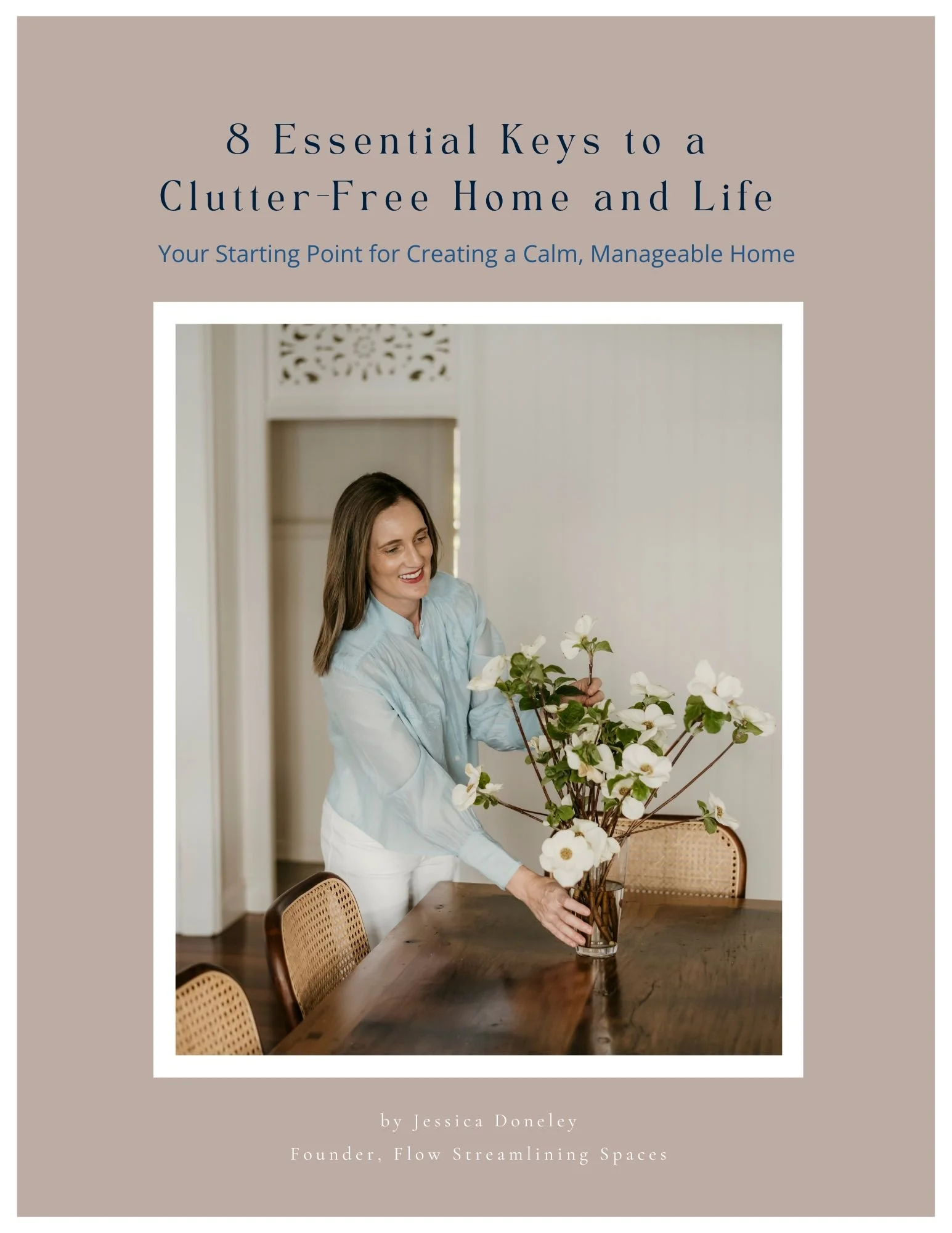
If this idea of enough resonates, my free guide 8 Essential Keys to a Clutter-Free Home and Life walks you through how to turn this decision into simple, realistic systems that reduce mental load and create flow — step by step, and at your own pace.
It’s a gentle starting point if your home feels overwhelming and you’re ready for things to feel easier.
Enough is a decision.
And you’re allowed to choose ease in this season.